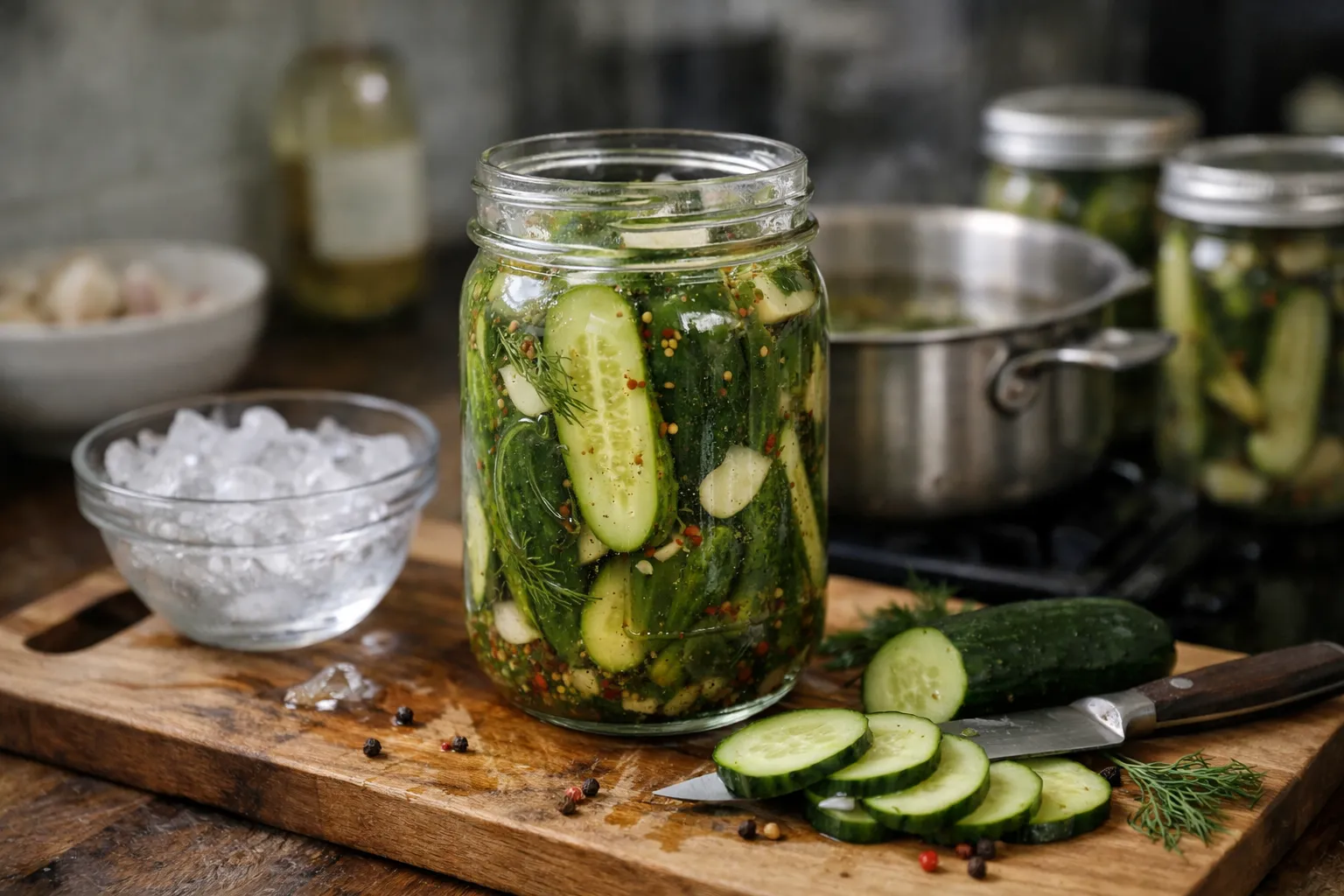
What you'll learn: How to make bright, crisp refrigerator pickles ready in 24–48 hours using a reliable 1:1 vinegar-to-water brine; how to maintain crunch (including food‑safe additives), reduce sodium, and adapt flavors following 2026 trends and safety guidance.
What you'll need
- Yield: about 1 quart (≈6 condiment servings).
- Time: 15–25 minutes active prep; flavor best at 48 hours; refrigerator storage 2–4 weeks.
- Equipment: clean 1‑quart jar with screw lid, small saucepan, measuring cups/spoons, sharp knife or mandoline, cutting board, bowl for ice water (optional), funnel (optional).
- Primary ingredients (base quart): 1 lb cucumbers (Kirby or English), 1 cup distilled white vinegar (5% acidity) + 1 cup water, 2 tbsp pickling or kosher salt, 2 tbsp granulated sugar (optional), 2 smashed garlic cloves, 1 tsp mustard seeds, 1 tsp black peppercorns, 1–2 sprigs fresh dill (or 1 tsp dried), 1 bay leaf.
- Optional: 1 small grape or oak leaf, or 1/8 tsp calcium chloride (commercial Pickle Crisp / calcium chloride, labelled E509) per quart to preserve crunch.
Why this method — what's new in 2026
Refrigerator pickles remain the fastest safe option to transform fresh produce without canning. Through 2024–2026 home cooks continued favoring quick, low‑waste preservation (farmers' market season extenders and leftover veg use). The core safety guidance from the National Center for Home Food Preservation and USDA still applies: these jars are not shelf‑stable and must be refrigerated.
Two practical updates for 2026: (1) calcium chloride products are now widely available in smaller consumer packages and are clearly labelled as "Pickle Crisp" or "calcium chloride — food grade (E509)"; use 1/8 tsp per quart when you want guaranteed crunch without bitter tannins. (2) Low‑sodium variations are more relevant—novel salt substitutes and erythritol‑based sweeteners are common and acceptable for flavoring, but reduce storage time (see Safety section).
Brine ratio and scaling (tested)
Use a 1:1 vinegar-to-water ratio with 2 tbsp pickling/kosher salt per quart for a reliable refrigerator-pickle brine. For tangier pickles raise vinegar to ~1.25 cups while reducing water accordingly. Multiply ingredients linearly for multiple quarts.
Step-by-step instructions
- Prep produce (5–10 minutes). Wash and trim cucumbers. Slice into 1/8–1/4" rounds or into spears so they pack snugly in the jar. If using radishes, carrots or onions, slice thinly so flavor penetrates fast. Expected result: uniform pieces that fit tightly in a quart jar.
- Optional crisping pre-step (2–3 minutes). For extra snap, submerge slices in an ice bath for 30–60 seconds and drain, or add a grape/oak leaf to the jar. If using calcium chloride, add it now (1/8 tsp per quart). Expected result: firmer texture retained after refrigeration.
- Make the brine (3–5 minutes). In a small saucepan bring vinegar, water, salt and sugar (if using) to just below boiling—heat only until salt and sugar dissolve; do not vigorously boil. Hot brine speeds infusion but minimal heating preserves vegetable texture. Expected result: clear brine with dissolved salt/sugar.
- Pack the jar (2–4 minutes). Tightly pack cucumbers with garlic, dill, mustard seeds, peppercorns and bay leaf. Leave 1/2" headspace. Expected result: little air space; aromatics distributed through the jar.
- Pour hot brine and seal. Pour hot brine over cucumbers, covering them completely and maintaining 1/2" headspace. Tap jar to release air bubbles, wipe rim, and screw on the lid. Expected result: cucumbers fully submerged; no floating pieces.
- Cool and refrigerate. Let jar cool to room temperature (~30–45 minutes), then refrigerate. Cold diffusion is the preservative/infusion method here. Expected result: pickles refrigerated within an hour and kept at ≤40°F (4°C).
- Wait and taste. Taste after 24 hours; best at 48 hours. Keep refrigerated; consume within 2–4 weeks. If you used reduced salt or no sugar, plan to consume within 2 weeks for best texture and safety.
Screenshots / visual cues (what you should see)
- Jar packed tightly, cucumbers mostly vertical or layered—no large air pockets visible.
- Brine clear and covering vegetables; spices (mustard seeds, peppercorns) visible settled among slices.
- After 24 hours: vegetables slightly translucent and the liquid tinted from aromatics.
- After 48 hours: flavor bright, cucumbers still crisp if kept chilled; soft or cloudy brine indicates discard.
Quick variations and 2026 flavor ideas
- Dill & garlic: Extra fresh dill and 2–3 garlic cloves for a classic.
- Spicy Korean‑style: Add 1 tbsp gochugaru or thinly sliced fresh chilies and 1 tsp grated ginger (trending on home ferment feeds in 2024–26).
- Bread‑and‑butter: Increase sugar to 1/3 cup, add 1/4 cup apple cider vinegar and 1/2 tsp turmeric for color.
- Herb-forward: Use tarragon or lemon thyme with lemon zest—reflects 2026 interest in herbaceous pickles paired with seafood and plant bowls.
- Pickled red onions: Use thinly sliced red onion; same brine but they’re crisp‑tender in 6–12 hours.
Dietary modifications (specifics)
- Low‑sodium: Reduce salt to 1 tbsp per quart; expect shorter refrigerated storage (consume within ~2 weeks). Rinse lightly before serving to lower sodium further.
- No‑sugar/keto: Omit sugar or replace with 2 tbsp erythritol or monk fruit sweetener; sweetness affects flavor more than safety because vinegar is the preservative.
- Vegan & gluten‑free: Base recipe is naturally vegan and typically gluten‑free—confirm any specialty vinegars or spice blends for gluten if you have celiac disease.
Tips for crisp pickles (practical)
- Choose young, firm cucumbers. Mature cucumbers have larger seeds and softer flesh.
- Calcium chloride (Pickle Crisp) reliably preserves crunch without changing taste—1/8 tsp per quart. Look for "food grade" or E509 on the label.
- Do not boil the brine; heat only to dissolve salt/sugar. Rapid boiling can soften vegetables.
- Pack tightly to minimize floating pieces; a snug jar reduces oxidation.
Food safety and storage (updated reminders)
Refrigerator pickles are safe when prepared on clean surfaces and kept refrigerated. They are not heat‑processed, so do not store at room temperature or expect shelf stability. The USDA and National Center for Home Food Preservation continue to recommend using a tested water‑bath canning recipe for shelf‑stable pickles. If brine becomes cloudy, develops off odors, or if there is mold, discard the jar. Keep refrigerated at or below 40°F (4°C).
Troubleshooting
- Soft pickles: Causes—overheated brine, overly mature produce, or no crisping agent. Remedy—use firmer cucumbers next time, reduce brine heating, add grape leaf or 1/8 tsp calcium chloride.
- Too salty: Rinse slices briefly before serving; reduce salt by 1/4–1/2 tbsp next batch.
- Not tangy enough: Increase vinegar to 1.25 cups per quart (reducing water) or let rest 48 hours for fuller flavor.
- Cloudy brine: Cloudiness can be a harmless sign of enzymatic activity or spice particulates; if accompanied by off odors or sliminess, discard.
Next steps
Once you’ve mastered the base quart, scale by multiplying ingredients for multiple jars. Experiment with one new flavor variable per batch (different vinegar, spice or herb). If you want shelf stability, consult tested water‑bath canning recipes from the National Center for Home Food Preservation or your local extension office.
FAQ
How long do refrigerator pickles last?
Stored continuously at ≤40°F (4°C), standard refrigerator pickles keep best for 2–4 weeks. If you reduced salt significantly, aim to consume within about 2 weeks. Discard if you notice mold, foul odors, or sliminess.
Can I use apple cider vinegar instead of white vinegar?
Yes. Apple cider vinegar (typically 5% acidity) works well and adds a fruitier flavor—popular for sweeter styles. For consistent acidity, use vinegars labelled 5% acidity; if unsure, use distilled white vinegar for the cleanest profile.
What's the difference between refrigerator pickles and fermented pickles?
Refrigerator pickles use vinegar for acidification and are chilled after brining. Fermented (lacto‑fermented) pickles rely on naturally occurring bacteria converting sugars to lactic acid; they ferment at room temperature for days to weeks and develop different tang and probiotics.
Is calcium chloride safe to use?
Yes. Food‑grade calcium chloride (often sold as Pickle Crisp) is recognized as safe and labeled E509. Use the manufacturer’s recommended amount—about 1/8 tsp per quart—to maintain crunch without affecting flavor.
Can I can these pickles for shelf stability?
No. These refrigerator‑pickle recipes are not processed for shelf stability. To store at room temperature, use a tested water‑bath canning recipe from USDA or a university extension and follow their processing times and safety steps.