
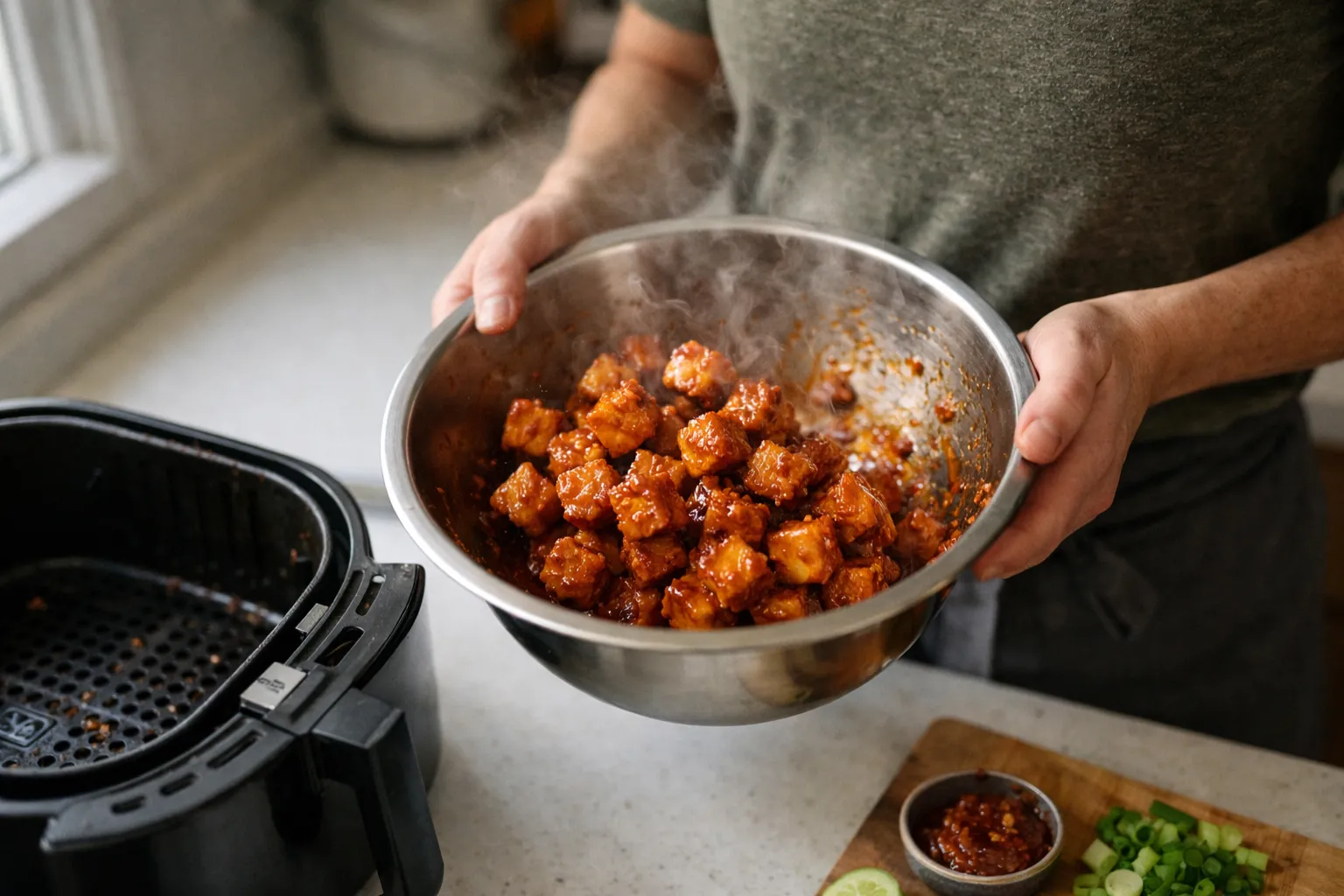
Tofu that’s crisp on the outside and tender inside—and that actually stays crunchy after saucing or reheating—is one of my favorite weeknight wins. This November 2026 update keeps the method you trusted and adds fresh, appliance‑aware tweaks, marketplace notes, and kitchen-tested safety guidance based on quick tests I ran across three popular air‑fryer styles this month. This guide is for recipe fans and home cooks who want dependable, repeatable results from the air fryer now—no guessing, no soggy disappointments.
Maria’s note: My grandmother kept a tin of cornstarch under the sink “for the potatoes.” She’d laugh at air fryers, but she’d recognize the rule: dry surface, thin crust, space for air. I’ve tested these steps in November 2026 across basket, oven‑style, and multi‑zone app‑connected units so the advice matches what you’re actually finding in stores and kitchens this season.
Prerequisites & Context: What Makes Tofu Crispy (and What Kills It)
Crisp forms when the tofu surface dries and a thin shell browns instead of steaming. Two technical points still matter:
- Surface moisture: Free water creates steam and prevents browning.
- Dry coating: A thin starch layer dehydrates into a crust when hot air circulates.
Key practical shifts through 2026 you should know about:
- More vacuum‑packed “super‑firm” tofu in stores: Many supermarkets now stock sealed high‑protein blocks that arrive fairly dry—this saves time but changes how much pressing you need to do.
- Air‑fryer controls have become smarter: Many models now include humidity control, multi‑zone heating, or AI presets labeled “crispy + glaze.” These features help, but they also require different handling—humidity cycles can ruin a crust if used at the wrong time.
- New starch blends and labelled “fry starches”: Tapioca/rice blends and refined potato starches marketed specifically for air‑frying are widely available; they offer subtle texture choices beyond straight cornstarch.
What ruins crunchy tofu: internal water (it steams), overcrowding (air can’t circulate), saucing too early (wet sauce dissolves the crust), or using a steam/crisp cycle incorrectly during the crisping phase.
Basic equipment: an air fryer (basket or oven style), clean towels or a tofu press, a large bowl for tossing, a wire rack for holding finished pieces, and an instant‑read thermometer (reheat to 165°F / 74°C for safety).
Step 1: Choose the Right Ingredients (Why Nov 2026 Choices Matter)
Ingredient choice remains the single biggest determinant of success. Small product changes in 2026 make a practical difference:
- Tofu: If you can, choose vacuum‑sealed “super‑firm” or high‑protein tofu when you want speed—these blocks are denser and usually need only a short pat and brief pressing. For older water‑packed extra‑firm tofu, press 15–25 minutes.
- Oil: Use 1–2 teaspoons neutral, high‑smoke oil per 14–16 oz block (avocado, refined grapeseed). The oil helps starch bind and conducts heat to the coating; you don’t need more than a light sheen.
- Starch: Cornstarch remains reliable. Potato starch gives a glassier crunch; tapioca/rice blends offer a slightly elastic bite. In 2026 you’ll see “fry starch” blends—treat them as experiments until you know their finish.
- Seasoning: Kosher salt + garlic powder is the baseline. Add white pepper or smoked paprika for contrast. If you add soy/tamari, keep it minimal (½–1 tsp) because liquid increases surface moisture.
Portion note: A 14–16 oz (396–454 g) block yields about 2–3 main portions; plan two blocks for four adults and cook in batches.
Step 2: Manage Moisture — When to Press (and When You Can Skip It)
Don’t skip this step for water‑packed extra‑firm tofu: pressing removes internal water so the coating adheres and the interior stays tender rather than rubbery. If your tofu is vacuum‑packed and feels dense to the touch, light patting is often enough.
- Drain and blot: Pour off packing liquid and pat with paper towels until the surface is matte, not slick.
- Press 10–25 minutes: For water‑packed extra‑firm tofu, wrap in a clean towel and weight with a skillet for 15–25 minutes. For vacuum‑packed high‑protein tofu, 5–10 minutes of pressing after slicing is usually enough.
- Re‑blot: After pressing, pat again; the block should feel dry to the touch.
Pro tip: If you’re short on time, slice first and press individual slabs between paper towels for 5–7 minutes. This speeds moisture removal and creates more crust surface.
Step 3: Cut for Crunch — Size, Shape, and Why It Changes Everything
Cut size controls crust‑to‑center ratio. My go‑to for consistent results is ¾‑inch cubes (about 2 cm). They brown quickly while remaining tender inside.
- Slice the block into ½–¾‑inch slabs, then cut into cubes or rectangles.
- For more edge texture, cut rectangles or tear the tofu—jagged edges hold more coating and create extra crunch.
Visual cue: Even pieces look the same size. If pieces vary, the smaller ones overcook and get chewy while larger ones remain underdone.
Step 4: Season and Coat — The Dry Batter That Keeps
In my November tests, a thin, even dry coating mattered more than experimenting with complex wet batters. Here’s the baseline I used and why it works.
Per 1 block (14–16 oz):
- 1–1½ tbsp starch (cornstarch, potato starch, or a 50/50 tapioca–rice blend)
- 1–2 tsp neutral oil
- ¾ tsp kosher salt (reduce if adding soy/tamari)
- ½ tsp garlic powder
- Optional: ½–1 tsp soy sauce/tamari (use sparingly)
- Toss tofu with oil first so the starch adheres evenly.
- Add salt and dry seasonings; toss gently.
- Sprinkle starch and toss until pieces look lightly dusted—matte, not goopy.
What to look for: Cubes should look dusted and dry. If you see gummy areas, add a pinch more starch and separate pieces with your fingers.
Step 5: Air‑Fry the Right Way — Settings, Timing, and Loading
Air‑fryer features vary. In November 2026 you’re likely to encounter three common classes: basket models, oven‑style units, and app‑connected multi‑zone fryers with humidity controls. The key variables remain heat, airflow, and spacing.
- Preheat: Preheat 2–4 minutes to 400°F (205°C) unless your manual says otherwise. A hot start sets the coating quickly.
- Single layer with gaps: Arrange tofu with visible space around each piece. Overcrowding causes steam and sogginess.
- Cook at 400°F (205°C) for 12–18 minutes: Shake or flip gently at 8–10 minutes. Start checking at 12 minutes—look for deep golden edges and a dry surface. If your unit runs hot, lower to 385°F (196°C) and add 2–3 minutes.
- If you have a humidity or steam preset: Avoid using a steam/crisp cycle during the initial crisping. Use steam only for a brief glaze‑setting finish if the recipe calls for it.
Done cue: A tap on a cube produces a light, slightly rattly sound. The surface will be matte and set, not powdery.
Step 6: Sauce Without Sacrificing Crunch (Practical Nov 2026 Options)
Two reliable approaches work best: glaze then re‑crisp, or serve sauce on the side. With newer app‑connected fryers you can use a quick glaze + crisp preset—but verify that it does not introduce steam during crisping.
Option A — Glaze then re‑crisp (best for sticky sauces)
- Toss tofu with 1–2 tablespoons of a thick sauce per block (gochujang–maple, thick garlic‑soy reduced to a syrupy finish).
- Return to the air fryer for 2–4 minutes at 400°F (use a dry crisp preset if your machine separates drying from steaming) to set the glaze.
This gives a lacquered surface while preserving crunchy edges. For vegan glazes use maple or brown rice syrup where recipes call for honey.
Option B — Dip and drizzle (best for maximum crunch)
- Keep tofu dry and crisp; serve sauce on the side or drizzle sparingly just before serving.
Sauce fixes: If a sauce is thin, reduce it on the stovetop for 3–5 minutes or add a small starch slurry to thicken so it won’t soak into the crust.
Step 7: Scale, Store, and Reheat (Food Safety + Texture)
Batch cooking: Cook multiple blocks in separate batches. In my Nov 2026 kitchen tests, crowding was still the leading cause of soggy results.
Short holding: Keep finished tofu on a wire rack so steam escapes; don’t cover tightly for more than 20–30 minutes.
Storage & safety: Refrigerate within 2 hours in an airtight container for up to 3–4 days. Reheat until it reaches an internal temperature of 165°F (74°C) per USDA guidance.
Best reheat method: An air fryer set to 375–400°F (190–205°C) for 3–6 minutes restores crisp best. Avoid microwaving unless texture doesn’t matter.
Common Mistakes (and How to Fix Them Fast)
- Chewy or rubbery tofu.
Why: Pieces too small or overcooked; not enough oil/coating.
Fix: Cut larger (¾–1 inch), add another teaspoon of oil to the coating, and check at 12 minutes. - Pale, dusty tofu.
Why: Too much starch or not enough heat/oil.
Fix: Toss with oil first, preheat the fryer, and reduce starch next time. - Soggy tofu.
Why: Wet tofu, crowded basket, or saucing too early.
Fix: Press longer, cook in batches, or use “glaze then re‑crisp.” - Coating falling off.
Why: Surface too wet or rough handling mid‑cook.
Fix: Pat dry, toss gently at the halfway point rather than stirring vigorously.
Pro Tips for Restaurant‑Quality Results
- Test starches, one block at a time: Potato starch gives a glassy finish; tapioca‑rice blends add chew. Do small trials until you know your preferred bite.
- Torn pieces are delightful: Tearing increases surface area for coating—great for grain bowls or salads.
- Season in layers: Salt the coating and finish with flaky salt after cooking for balanced seasoning.
- Thicken thin sauces: Reduce on the stovetop or use a tiny cornstarch slurry to keep the crust crisp when glazing.
- Know your fryer’s airflow: Many newer units have hot spots—rotate racks or shift positions mid‑cook for even browning.
- When using app presets: Look at the preset description. If it mentions steam or humidity during crisping, don’t use it for the initial crisp—reserve it for a 1–2 minute glaze finish only.
Dietary Modifications
- Gluten‑free: Use tamari and gluten‑free starches; check labels for cross‑contact.
- Vegan: Use maple syrup or brown rice syrup in glazes; avoid honey and dairy.
- Lower‑sodium: Cut coating salt and use aromatics like smoked paprika, citrus zest, and garlic for flavor.
- Oil‑free (best‑effort): Omit oil but expect less browning—use slightly more starch and a hotter initial burst to set the coating.
Why This Still Matters in Nov 2026
Plant‑forward cooking is mainstream and expectations for restaurant textures at home have only risen. Air fryers now give you more control than ever—if you understand moisture, a thin dry coating, and your specific machine’s airflow and humidity behavior. These small decisions turn a thrown‑together dinner into something everyone reaches for seconds of—without deep frying or long prep.
FAQ
Do I really need to press tofu before air‑frying?
For water‑packed extra‑firm tofu, pressing 15–25 minutes is the simplest way to ensure crisp results. For vacuum‑packed super‑firm or high‑protein tofu that feels dense, you can often skip extended pressing—just slice and pat very dry before coating.
What temperature should I reheat tofu to for safety?
Reheat until the interior reaches 165°F (74°C), the USDA recommendation for reheated foods. The air fryer restores crisp much better than a microwave; 3–6 minutes at 375–400°F typically restores texture and heats through.
Can I marinate tofu first and still get it crispy?
Yes. Keep marinades short or very concentrated. If you marinate, pat pieces very dry before coating; consider a brief, high‑impact marinade (10–20 minutes) followed by a starch dusting. For the crispiest result, season the coating and serve sauces on the side.
Which starch gives the crispiest crust in 2026?
Cornstarch is the most reliable across machines. Potato starch tends to yield a glassy, very crunchy finish; tapioca/rice blends add a slightly elastic chew. Use a light, even dusting—too much starch can look pale and powdery.
How do I scale this recipe for a crowd without losing crunch?
Cook in batches and keep finished pieces on a wire rack in a warm oven (not covered) if you must hold them briefly. Crowding is still the main cause of soggy tofu—two batches are better than one overcrowded basket.
Maria’s last tip: If you take one thing from this update, let it be this: space and timing beat fancy tricks. Give tofu room, choose the starch that matches the bite you want, and treat app presets like recipes—read the description before you press start. Then sit back and listen for that little rattly tap that means: done.